
Al descargar el documento usted acepta los términos establecidos en el copyright del documento y la política de uso de la plataforma.
Biblioteca
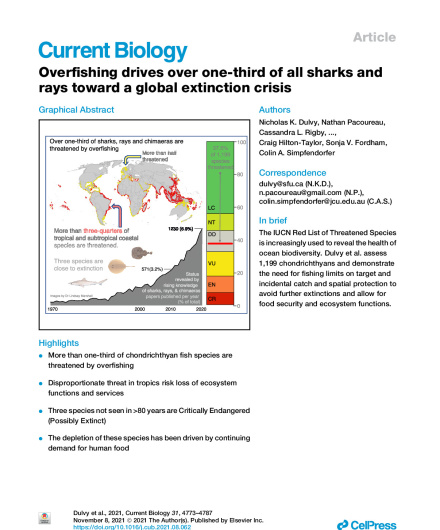
Overfishing drives over one-third of all sharks and rays toward a global extinction crisis

Iniciativas sostenibles
Sectores productivos
Año de la publicación:
2021
Autor:
Nicholas K. Dulvy
Nathan Pacoureau
Cassandra L. Rigby
Riley A. Pollom
Rima W. Jabado
David A. Ebert
Brittany Finucci
Caroline M. Pollock
Jessica Cheok
Danielle H. Derrick
Katelyn B. Herman
C. Samantha Sherman
Wade J. VanderWright
Julia M. Lawson
Rachel H.L. Walls
John K. Carlson
Patricia Charvet
Kinattumkara K. Bineesh
Daniel Fernando
Gina M. Ralph
Jay H. Matsushiba
Taylor Craig Hilton
Sonja V. Fordham
Colin A. Simpfendorfer
Lugar de incidencia:
Global
Región oceánica:
Cosmopolita
The scale and drivers of marine biodiversity loss are being revealed by the International Union for Conservation of Nature (IUCN) Red List assessment process. We present the first global reassessment of 1,199 species in Class Chondrichthyes—sharks, rays, and chimeras. The first global assessment (in 2014) concluded that one-quarter (24%) of species were threatened. Now, 391 (32.6%) species are threatened with extinction. When this percentage of threat is applied to Data Deficient species, more than one-third (37.5%) of chondrichthyans are estimated to be threatened, with much of this change resulting from new information. Three species are Critically Endangered (Possibly Extinct), representing possibly the first global marine fish extinctions due to overfishing. Consequently, the chondrichthyan extinction rate is potentially 25 extinctions per million species years, comparable to that of terrestrial vertebrates. Overfishing is the universal threat affecting all 391 threatened species and is the sole threat for 67.3% of species and interacts with three other threats for the remaining third: loss and degradation of habitat (31.2% of threatened species), climate change (10.2%), and pollution (6.9%). Species are disproportionately threatened in tropical and subtropical coastal waters...
Etiquetas:
© 2021 The Author(s). Published by Elsevier Inc. This is an open access article under the CC BY license (http://creativecommons.org/licenses/by/4.0/).
La estructura de clasificación de la lista de especies Blue Five para la biblioteca digital ha sido
elaborada siguiendo criterios tanto científicos como de accesibilidad para facilitar la búsqueda de
información. En primer lugar, se organizaron las especies basándose en la taxonomía aceptada por la
comunidad científica para garantizar precisión y coherencia. Simultáneamente, se han implementado
categorías y subcategorías, considerando características morfológicas, su distribución y el uso de los
nombres comunes, con el fin de optimizar la navegación y búsqueda de datos por parte de los usuarios.
Esta metodología equilibrada asegura que la lista no solo sea científicamente rigurosa, sino también
fácil de consultar para quienes necesiten acceder a información específica de manera eficiente.
ISBN/ISSN/DOI:
https://doi.org/10.1016/j.cub.2021.08.062
Editor:
Elsevier
Idioma:
Inglés
Fuente:
Current Biology
Especies mencionadas:
- Categoría Blue Five: Tiburones Mantarrayas
- Familia: Tiburones cazones Tiburones martillo Mantarrayas y móbulas
- Especies: Tiburón galano (Negaprion brevirostris) Tintorera/Tiburón coralero ñato (Triaenodon obesus) Tiburón cornuda coronada (Sphyrna corona) Mantarraya de arrecife (Mobula alfredii) Mantarraya gigante (Mobula birostris)
Documentos relacionados:
Iniciativas sostenibles
Whale watching in northern Peru: An economic boom?
Whale-watching tourism is growing rapidly worldwide. Currently, it occurs in more than 119 countries and is estimated to produce more...
Iniciativas sostenibles
How marine plastic debris shapes tourist behavior: Willingness to return...
Marine plastic pollution poses a growing threat to tourism-dependent economies, particularly in regions reliant on pristine beach environments such as...
Iniciativas sostenibles
Whale-watching tourism as a driving force for socioeconomic development in...
We aim to analyze the socioeconomic impact of the whale-watching industry in one of the poorest areas in Ecuador. Puerto...