
Al descargar el documento usted acepta los términos establecidos en el copyright del documento y la política de uso de la plataforma.
Biblioteca
Use of small cetaceans as bait in small-scale fisheries in Peru

Monitoreo de especies
Metodologías de monitoreo
Año de la publicación:
2020
Autor:
Elizabeth Campbell
Andrea Pasara Polack
Jeffrey C. Mangel
Joanna Alfaro Shigueto
Lugar de incidencia:
Perú
Región oceánica:
Pacífico - Sudeste
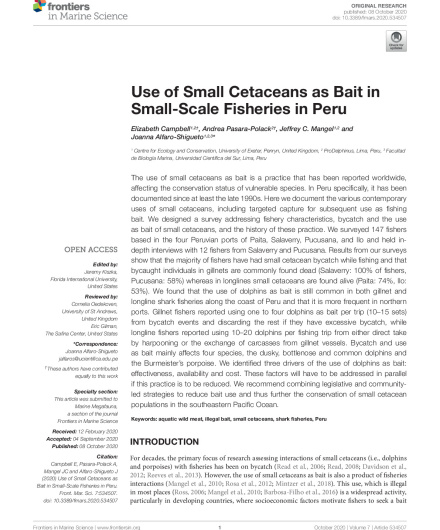
The use of small cetaceans as bait is a practice that has been reported worldwide, affecting the conservation status of vulnerable species. In Peru specifically, it has been documented since at least the late 1990s. Here we document the various contemporary uses of small cetaceans, including targeted capture for subsequent use as fishing bait. We designed a survey addressing fishery characteristics, bycatch and the use as bait of small cetaceans, and the history of these practice. We surveyed 147 fishers based in the four Peruvian ports of Paita, Salaverry, Pucusana, and Ilo and held in-depth interviews with 12 fishers from Salaverry and Pucusana. Results from our surveys show that the majority of fishers have had small cetacean bycatch while fishing and that bycaught individuals in gillnets are commonly found dead (Salaverry: 100% of fishers, Pucusana: 58%) whereas in longlines small cetaceans are found alive (Paita: 74%, Ilo: 53%). We found that the use of dolphins as bait is still common in both gillnet and longline shark fisheries along the coast of Peru and that it is more frequent in northern ports. Gillnet fishers reported using one to four dolphins as bait per trip (10–15 sets) from bycatch events and discarding the rest if they have excessive bycatch, while longline...
Etiquetas:
© 2020 Campbell, Pasara-Polack, Mangel and Alfaro-Shigueto. This is an open-access article distributed under the terms of the Creative Commons Attribution License (CC BY). The use, distribution or reproduction in other forums is permitted, provided the original author(s) and the copyright owner(s) are credited and that the original publication in this journal is cited, in accordance with accepted academic practice. No use, distribution or reproduction is permitted which does not comply with these terms.
La estructura de clasificación de la lista de especies Blue Five para la biblioteca digital ha sido
elaborada siguiendo criterios tanto científicos como de accesibilidad para facilitar la búsqueda de
información. En primer lugar, se organizaron las especies basándose en la taxonomía aceptada por la
comunidad científica para garantizar precisión y coherencia. Simultáneamente, se han implementado
categorías y subcategorías, considerando características morfológicas, su distribución y el uso de los
nombres comunes, con el fin de optimizar la navegación y búsqueda de datos por parte de los usuarios.
Esta metodología equilibrada asegura que la lista no solo sea científicamente rigurosa, sino también
fácil de consultar para quienes necesiten acceder a información específica de manera eficiente.
ISBN/ISSN/DOI:
doi: 10.3389/fmars.2020.534507
Editor:
Frontiers in Marine Science
Idioma:
Inglés
Fuente:
"This article was submitted to Marine Megafauna, a section of the journal Frontiers in Marine Science"
Especies mencionadas:
- Categoría Blue Five: Delfines Tiburones
- Familia: Delfines Marsopas Tiburones martillo
- Especies: Delfín común (Delphinus sp.) Delfín nariz de botella (Tursiops truncatus) Marsopa espinosa (Phocoena spinipinnis) Tiburón martillo (Sphyrna zygaena)
Documentos relacionados:
Monitoreo de especies
Vulnerability of Eastern Tropical Pacific chondrichthyan fish to climate change
El cambio climático es una emergencia medioambiental que amenaza a especies y ecosistemas en todo el mundo. Los océanos han...
Monitoreo de especies
Imminent risk of extirpation for two bottlenose dolphin communities in...
A long-term study of a common bottlenose dolphin (Tursiops truncatus) population inhabiting the Gulf of Guayaquil, Ecuador (2°33′...
Monitoreo de especies
Cranial variation between coastal and offshore bottlenose dolphins, Tursiops truncatus...
Skull shape analysis provides useful information on wildlife ecology and potential local adaptations. Common bottlenose dolphins (Tursiops truncatus)...