
Al descargar el documento usted acepta los términos establecidos en el copyright del documento y la política de uso de la plataforma.
Biblioteca
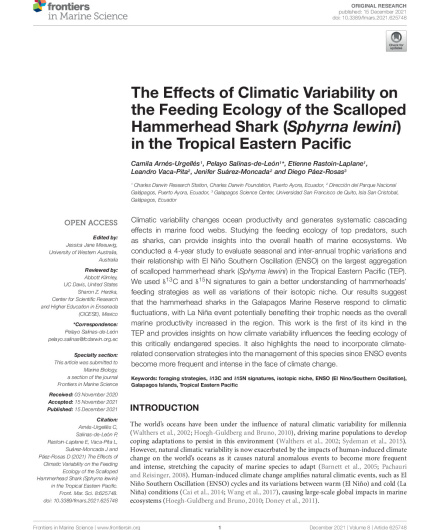
The effects of climatic variability on the feeding ecology of the scalloped hammerhead shark (Sphyrna lewini) in the Tropical Eastern Pacific

Monitoreo de especies
Metodologías de monitoreo
Año de la publicación:
2021
Autor:
Camila Arnés Urgellés
Pelayo Salinas de León
Etienne Rastoin Laplane
Leandro Vaca Pita
Jenifer Suárez Moncada
Diego Páez Rosas
Lugar de incidencia:
Ecuador
Región oceánica:
Pacífico - Sudeste
Climatic variability changes ocean productivity and generates systematic cascading effects in marine food webs. Studying the feeding ecology of top predators, such as sharks, can provide insights into the overall health of marine ecosystems. We conducted a 4-year study to evaluate seasonal and inter-annual trophic variations and their relationship with El Niño Southern Oscillation (ENSO) on the largest aggregation of scalloped hammerhead shark (Sphyrna lewini) in the Tropical Eastern Pacific (TEP). We used δ13C and δ15N signatures to gain a better understanding of hammerheads’ feeding strategies as well as variations of their isotopic niche. Our results suggest that the hammerhead sharks in the Galapagos Marine Reserve respond to climatic fluctuations, with La Niña event potentially benefiting their trophic needs as the overall marine productivity increased in the region. This work is the first of its kind in the TEP and provides insights on how climate variability influences the feeding ecology of this critically endangered species. It also highlights the need to incorporate climate-related conservation strategies into the management of this species since ENSO events become more frequent and intense in the face of climate change.
Etiquetas:
© 2021 Arnés-Urgellés, Salinas-de-León, Rastoin-Laplane, Vaca-Pita, Suárez-Moncada and Páez-Rosas. This is an open-access article distributed under the terms of the Creative Commons Attribution License (CC BY). The use, distribution or reproduction in other forums is permitted, provided the original author(s) and the copyright owner(s) are credited and that the original publication in this journal is cited, in accordance with accepted academic practice. No use, distribution or reproduction is permitted which does not comply with these terms.
La estructura de clasificación de la lista de especies Blue Five para la biblioteca digital ha sido
elaborada siguiendo criterios tanto científicos como de accesibilidad para facilitar la búsqueda de
información. En primer lugar, se organizaron las especies basándose en la taxonomía aceptada por la
comunidad científica para garantizar precisión y coherencia. Simultáneamente, se han implementado
categorías y subcategorías, considerando características morfológicas, su distribución y el uso de los
nombres comunes, con el fin de optimizar la navegación y búsqueda de datos por parte de los usuarios.
Esta metodología equilibrada asegura que la lista no solo sea científicamente rigurosa, sino también
fácil de consultar para quienes necesiten acceder a información específica de manera eficiente.
ISBN/ISSN/DOI:
doi: 10.3389/fmars.2021.625748
Editor:
Frontiers in Marine Science
Idioma:
Inglés
Fuente:
Marine Biology
Especies mencionadas:
- Categoría Blue Five: Tiburones
- Familia: Tiburones martillo
- Especies: Tiburón martillo común (Sphyrna lewini)
Documentos relacionados:
Monitoreo de especies
Vulnerability of Eastern Tropical Pacific chondrichthyan fish to climate change
El cambio climático es una emergencia medioambiental que amenaza a especies y ecosistemas en todo el mundo. Los océanos han...
Monitoreo de especies
Imminent risk of extirpation for two bottlenose dolphin communities in...
A long-term study of a common bottlenose dolphin (Tursiops truncatus) population inhabiting the Gulf of Guayaquil, Ecuador (2°33′...
Monitoreo de especies
Cranial variation between coastal and offshore bottlenose dolphins, Tursiops truncatus...
Skull shape analysis provides useful information on wildlife ecology and potential local adaptations. Common bottlenose dolphins (Tursiops truncatus)...