
Al descargar el documento usted acepta los términos establecidos en el copyright del documento y la política de uso de la plataforma.
Biblioteca
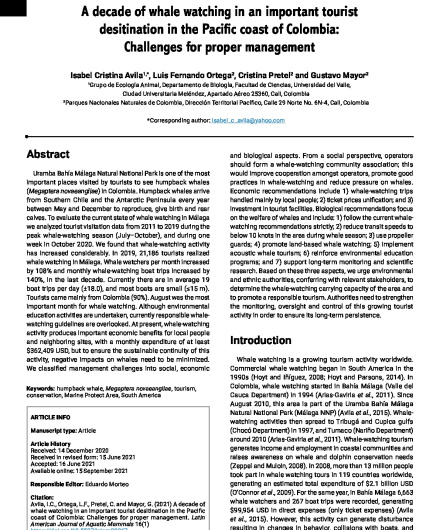
A decade of whale watching in an important tourist destination in the Pacific coast of Colombia: Challenges for proper management

Iniciativas sostenibles
Turismo sostenible
Año de la publicación:
2021
Autor:
Isabel Cristina Avila
Luis Fernando Ortega
Cristina Pretel
Gustavo Mayor
Lugar de incidencia:
Colombia
Región oceánica:
Pacífico - Sudeste
Whale watching is a growing tourism activity worldwide. Commercial whale watching began in South America in the 1990s (Hoyt and Iñíguez, 2008; Hoyt and Parsons, 2014). In Colombia, whale watching started in Bahía Málaga (Valle del Cauca Department) in 1994 (Arias-Gaviria et al., 2011). Since August 2010, this area is part of the Uramba Bahía Málaga Natural National Park (Málaga NNP) (Avila et al., 2015). Whale-watching activities then spread to Tribugá and Cupica gulfs (Chocó Department) in 1997, and Tumaco (Nariño Department) around 2010 (Arias-Gaviria et al., 2011). Whale-watching tourism generates income and employment in coastal communities and raises awareness on whale and dolphin conservation needs (Zeppel and Muloin, 2008).
Etiquetas:
La estructura de clasificación de la lista de especies Blue Five para la biblioteca digital ha sido
elaborada siguiendo criterios tanto científicos como de accesibilidad para facilitar la búsqueda de
información. En primer lugar, se organizaron las especies basándose en la taxonomía aceptada por la
comunidad científica para garantizar precisión y coherencia. Simultáneamente, se han implementado
categorías y subcategorías, considerando características morfológicas, su distribución y el uso de los
nombres comunes, con el fin de optimizar la navegación y búsqueda de datos por parte de los usuarios.
Esta metodología equilibrada asegura que la lista no solo sea científicamente rigurosa, sino también
fácil de consultar para quienes necesiten acceder a información específica de manera eficiente.
ISBN/ISSN/DOI:
DOI: https://doi.org/10.5597/lajam00267
Editor:
Latin American Journal of Aquatic Mammals, 16(1), 23-32
Idioma:
Inglés
Fuente:
Latin American Journal of Aquatic Mammals
Especies mencionadas:
- Categoría Blue Five: Ballenas
Documentos relacionados:
Iniciativas sostenibles
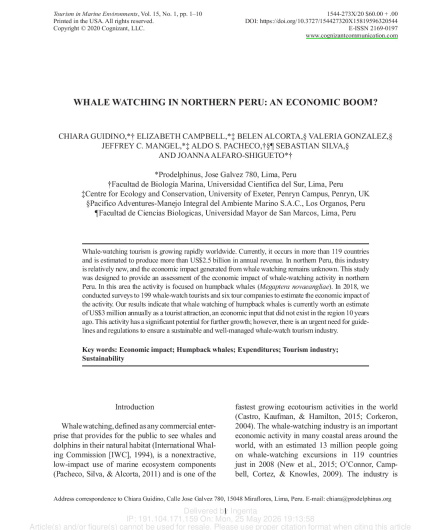
Whale watching in northern Peru: An economic boom?
Whale-watching tourism is growing rapidly worldwide. Currently, it occurs in more than 119 countries and is estimated to produce more...
Iniciativas sostenibles
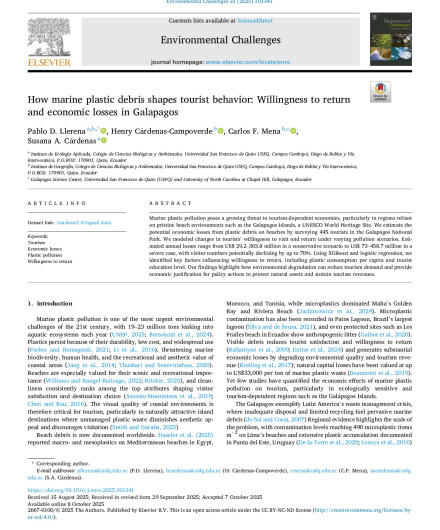
How marine plastic debris shapes tourist behavior: Willingness to return...
Marine plastic pollution poses a growing threat to tourism-dependent economies, particularly in regions reliant on pristine beach environments such as...
Iniciativas sostenibles
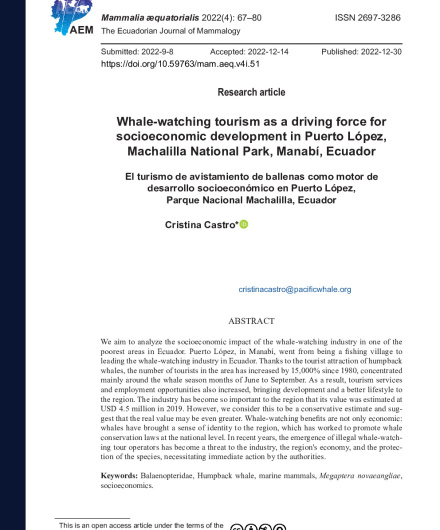
Whale-watching tourism as a driving force for socioeconomic development in...
We aim to analyze the socioeconomic impact of the whale-watching industry in one of the poorest areas in Ecuador. Puerto...