
Al descargar el documento usted acepta los términos establecidos en el copyright del documento y la política de uso de la plataforma.
Biblioteca
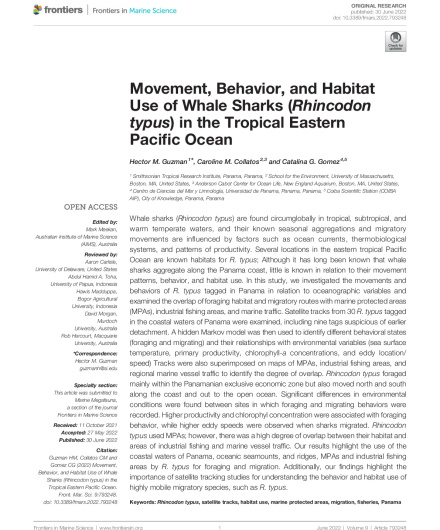
Movement, behavior, and habitat use of whale sharks (Rhincodon typus) in the Tropical Eastern Pacific Ocean

Monitoreo de especies
Metodologías de monitoreo
Año de la publicación:
2022
Autor:
Hector M. Guzman
Caroline M. Collatos
Catalina G. Gomez
Lugar de incidencia:
Panamá
Región oceánica:
Pacífico - Sudeste
Whale sharks (Rhincodon typus) are found circumglobally in tropical, subtropical, and warm temperate waters, and their known seasonal aggregations and migratory movements are influenced by factors such as ocean currents, thermobiological systems, and patterns of productivity. Several locations in the eastern tropical Pacific Ocean are known habitats for R. typus; Although it has long been known that whale sharks aggregate along the Panama coast, little is known in relation to their movement patterns, behavior, and habitat use. In this study, we investigated the movements and behaviors of R. typus tagged in Panama in relation to oceanographic variables and examined the overlap of foraging habitat and migratory routes with marine protected areas (MPAs), industrial fishing areas, and marine traffic.
Etiquetas:
© 2022 Guzman, Collatos and Gomez. This is an open-access article distributed under the terms of the Creative Commons Attribution License (CC BY). The use, distribution or reproduction in other forums is permitted, provided the original author(s) and the copyright owner(s) are credited and that the original publication in this journal is cited, in accordance with accepted academic practice. No use, distribution or reproduction is permitted which does not comply with these terms.
La estructura de clasificación de la lista de especies Blue Five para la biblioteca digital ha sido
elaborada siguiendo criterios tanto científicos como de accesibilidad para facilitar la búsqueda de
información. En primer lugar, se organizaron las especies basándose en la taxonomía aceptada por la
comunidad científica para garantizar precisión y coherencia. Simultáneamente, se han implementado
categorías y subcategorías, considerando características morfológicas, su distribución y el uso de los
nombres comunes, con el fin de optimizar la navegación y búsqueda de datos por parte de los usuarios.
Esta metodología equilibrada asegura que la lista no solo sea científicamente rigurosa, sino también
fácil de consultar para quienes necesiten acceder a información específica de manera eficiente.
ISBN/ISSN/DOI:
https://doi.org/10.3389/fmars.2022.793248
Editor:
Frontiers in Marine Science
Idioma:
Inglés
Fuente:
This article was submitted to Marine Megafauna, a section of the journal Frontiers in Marine Science
Especies mencionadas:
- Categoría Blue Five: Tiburones
- Familia: Tiburones ballena
- Especies: Tiburón ballena (Rhincodon typus)
Documentos relacionados:
Monitoreo de especies
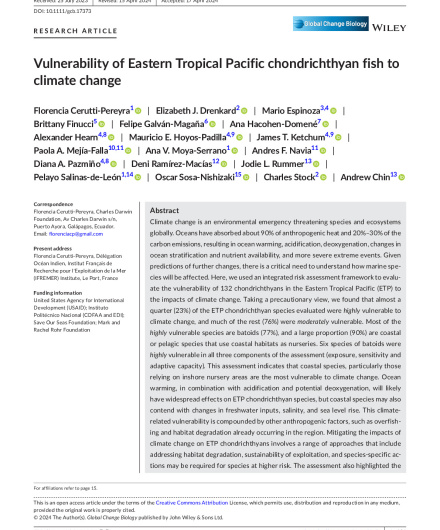
Vulnerability of Eastern Tropical Pacific chondrichthyan fish to climate change
El cambio climático es una emergencia medioambiental que amenaza a especies y ecosistemas en todo el mundo. Los océanos han...
Monitoreo de especies
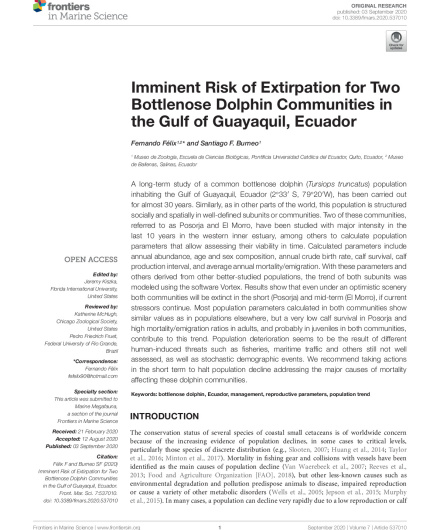
Imminent risk of extirpation for two bottlenose dolphin communities in...
A long-term study of a common bottlenose dolphin (Tursiops truncatus) population inhabiting the Gulf of Guayaquil, Ecuador (2°33′...
Monitoreo de especies
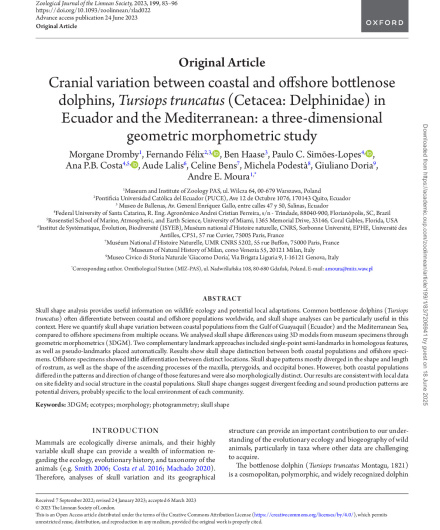
Cranial variation between coastal and offshore bottlenose dolphins, Tursiops truncatus...
Skull shape analysis provides useful information on wildlife ecology and potential local adaptations. Common bottlenose dolphins (Tursiops truncatus)...